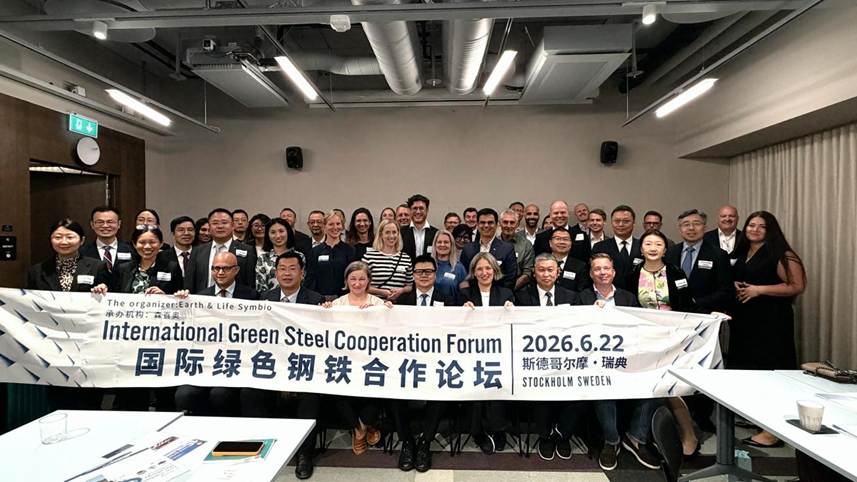
Stockholm, 22 June 2026 — Earth & Life Symbio (E&L) launched the International Green Steel Cooperation Forum in Stockholm in June 2026, creating a new platform for dialogue among stakeholders working across the green steel value chain.

Convened during E&L’s European Green Steel Study Tour, the Forum brought together more than 50 representatives from steel producers, mining companies, downstream manufacturers, financial institutions, asset managers, industry associations, research organisations, civil society organisations and philanthropic foundations. Participants included representatives from organisations such as the China Iron and Steel Association (CISA), China Baowu, Shougang Group, CITIC Pacific Special Steel, Stegra, SSAB, Outokumpu, BMW, KONE, ING, HSBC, Nordea Asset Management, SEB Asset Management, Storebrand Asset Management, ResponsibleSteel and RMI.
The forum was held at a pivotal moment for the global steel sector. Steel remains one of the most emissions-intensive industries, yet the technologies needed to reduce emissions are increasingly moving beyond pilot projects. The central question is how to create the conditions that allow these technologies to scale: affordable renewable electricity, reliable hydrogen supply, access to suitable raw materials, robust policy frameworks, credible standards, sufficient investment and dependable market demand.
Against this backdrop, the forum offered a setting for participants to discuss not only ambitions for green steel, but also the commercial, financial and policy realities that can either enable or delay its deployment.
Discussions focused on several interconnected issues. Participants examined how transition-finance models and risk-sharing mechanisms could help mobilise capital for first-of-a-kind and scaling projects. They discussed the need for stronger demand-side signals, including long-term procurement commitments from automotive, construction and other downstream sectors. They also explored the role of carbon accounting, standards and certification in building market trust, as well as the implications of trade rules and policy instruments such as the EU CBAM.

One clear message was that carbon pricing alone is unlikely to unlock the scale of investment required. For project developers and lenders alike, the bankability of green steel projects depends on a combination of policy certainty, viable business models, secure energy supply and credible long-term demand. Participants emphasised the importance of connecting industrial companies more closely with financial institutions, investors and downstream buyers so that risks and opportunities can be understood across the full value chain.
The dialogue also highlighted the value of candid China–Europe exchange. China and Europe face many shared challenges: reducing emissions while preserving industrial competitiveness, mobilising capital for large-scale investments, securing resilient supply chains and creating markets that reward lower-carbon products. At the same time, their industrial structures, energy systems, resource endowments and policy frameworks differ significantly.

For E&L, the forum reflects a conviction that industrial decolonization is a collective systems challenge. Steel producers cannot make the transition alone; neither can financiers, policymakers or buyers. Meaningful progress requires dialogue across the supply chain and across regions, especially where different perspectives and commercial realities need to be reconciled.
The launch of the International Green Steel Cooperation Forum marks the beginning of a longer-term effort, rather than a one-off event. E&L will continue to use the forum to connect stakeholders, support reciprocal exchange and translate dialogue into more sustained collaboration on market development, transition finance, standards and industrial transformation.
At a time when international cooperation is becoming more complex, the forum aims to preserve a trusted space for practical, solutions-oriented engagement—and to help move green steel from pioneering projects towards wider commercial adoption.