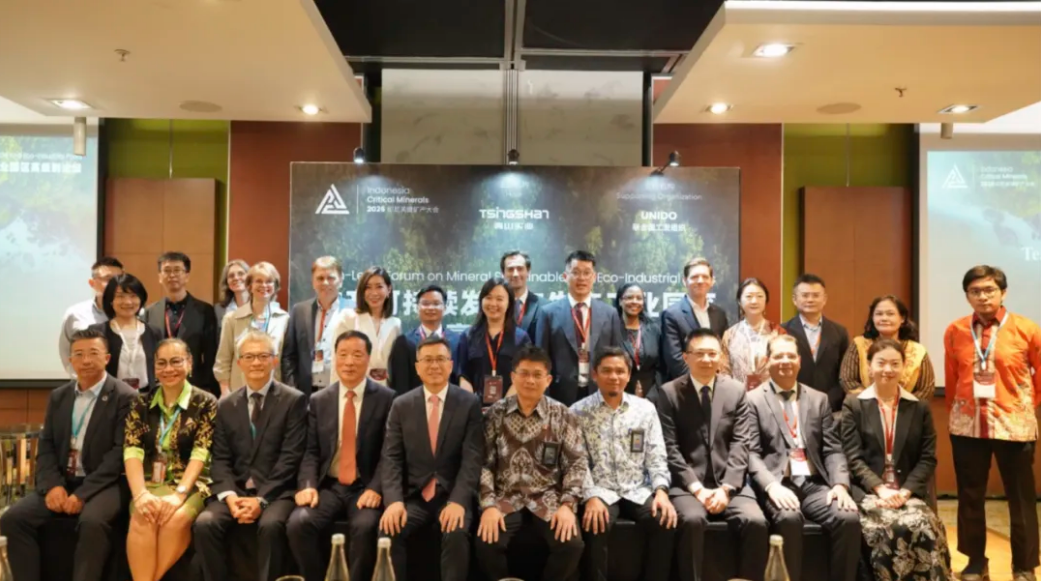
Jakarta, 4 June 2026 — In early June 2026, Jakarta became a focal point for discussions on critical minerals, supply-chain cooperation and industrial sustainability. Earth & Life Symbio (E&L) joined two key events: the Second ESG Forum hosted by the Indonesian Nickel Miners Association (APNI) on 2 June, and the High-Level Forum on Mineral Sustainable and Eco-Industrial Parks, co-hosted by Tsingshan Group and the United Nations Industrial Development Organization (UNIDO) on 4 June.

Together, the conversations highlighted a sector facing rapidly rising expectations. Indonesia, as the world’s largest nickel producer, is central to global battery, electric-vehicle and steel supply chains. Its sustainability performance therefore matters not only domestically, but also for investors, downstream buyers and the credibility of the global energy transition.
From compliance to locally grounded ESG
At the APNI forum, held under the theme “Shaping Indonesia ESG Standards: From Compliance to Global Market Recognition,” participants explored a fundamental question: what should ESG mean in a producing country?
Indonesian policymakers and industry representatives emphasized that ESG cannot be limited to reporting, ratings or presentation slides. It must lead to tangible outcomes: cleaner environments, safer workplaces and stronger local economic participation.
This reflects a wider concern among resource-producing countries. International ESG expectations are often shaped outside producing regions, while implementation costs and responsibilities fall locally. Indonesia is seeking not to reject global frameworks, but to develop a national mining ESG framework that aligns with international standards while remaining relevant to Indonesian conditions.
The challenge is substantial. Indonesia has around 10,000 mining companies, yet ESG capability remains uneven. Effective due diligence must move beyond proof of compliance towards credible risk identification, grievance mechanisms and remediation.
A crowded standards landscape—and rising market pressure
The UNIDO–Tsingshan forum focused on the practical challenge of implementation. Companies in Indonesia’s nickel sector must navigate a growing range of international frameworks—including IRMA, the Responsible Minerals Initiative, the Nickel Mark and IFC Performance Standards—alongside extensive domestic regulations.
The issue is no longer a lack of standards, but limited alignment and mutual recognition between them. This can make compliance costly and confusing, particularly for companies trying to connect mine-level practice with the expectations of global customers and financiers.
The EU Battery Regulation adds urgency. From 2027, battery value chains serving the European market will face requirements related to carbon-footprint declarations and due diligence. Although the policy direction is clear, many companies still need a more practical roadmap from Indonesian nickel production to batteries placed on the EU market.
Financial institutions delivered an equally clear message: ESG performance is increasingly a business and credit issue. Strong sustainability practices can support market access and financing opportunities, while weak performance can create material commercial risk.
Biodiversity: a critical issue still at the margins
Across both events, E&L observed that biodiversity received much less attention than carbon, climate and compliance. Yet this is a major blind spot for an industry operating in ecologically sensitive landscapes.
Nature-related risks are already translating into financial, regulatory and operational consequences. In September 2025, Norway’s sovereign wealth fund divested from Eramet over concerns about environmental damage and human rights risks linked to the Weda Bay nickel operation. In 2026, the Indonesian Government significantly reduced the site’s annual mining quota, while operations were paused after the quota was exhausted.
At the 4 June forum, Eramet shared its biodiversity action plan for Weda Bay, drawing on IFC Performance Standards and aiming for a net-positive biodiversity outcome. This signals a broader shift: nature is moving from a voluntary commitment to an issue increasingly shaped by investor scrutiny, regulatory decisions and operational resilience.
Biodiversity risks need to be integrated more systematically into supply-chain ESG assessment, supported by credible methodologies, baseline data and transparent disclosure.
Building bridges across the ESG ecosystem
The two events reflected different but connected priorities. The APNI forum foregrounded Indonesia’s effort to develop a nationally grounded ESG architecture, while the UNIDO–Tsingshan forum focused on implementation challenges and the experiences of companies operating at the industry frontier.
E&L’s key takeaway is that the sector does not simply need more standards or more reporting. It needs stronger bridges between local practice, international expectations and credible action.
Chinese companies play an important role in Indonesia’s nickel value chain, yet their ESG practices are often difficult for external stakeholders to assess. Positive practices are not always visible, while gaps are not consistently identified through comparable information. Investors need reliable insight; policymakers need usable benchmarks; and companies need clearer pathways to connect local practice with global expectations.
E&L will continue to engage at the intersection of nature and biodiversity disclosure, green finance and sustainable supply chains. As critical minerals become increasingly central to the energy transition, greater transparency, dialogue and shared action will be essential to ensuring that the transition is not only fast, but also responsible.