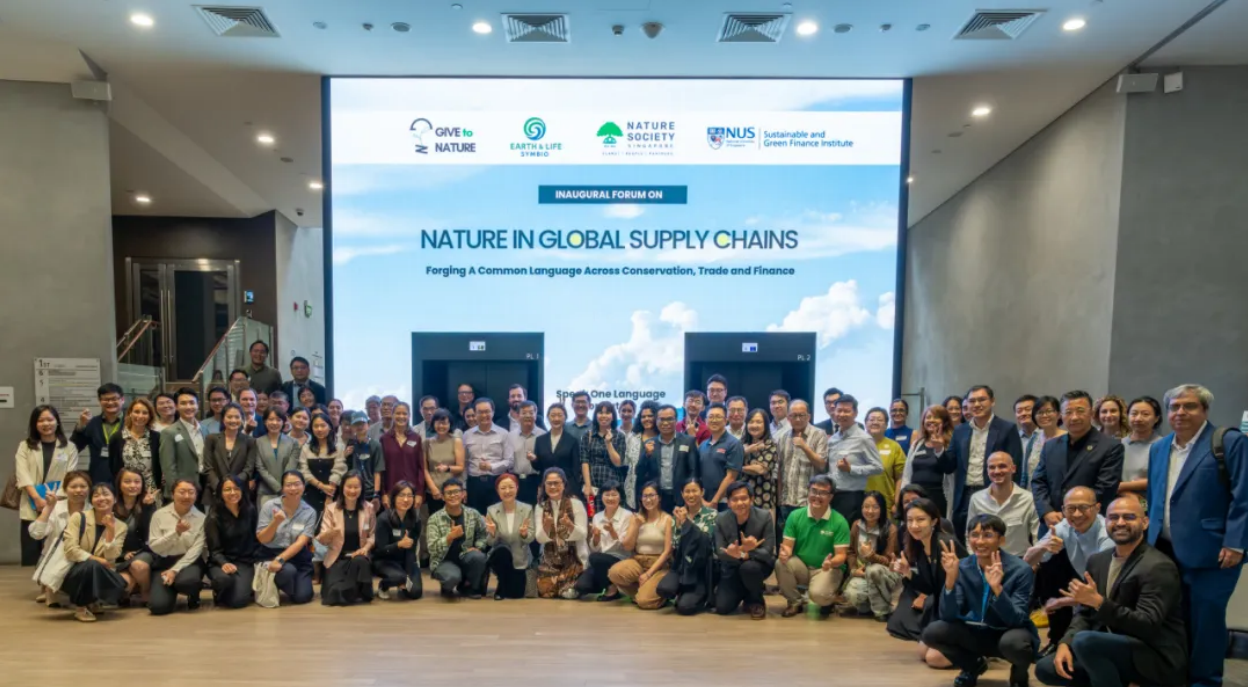
Singapore, 1st April 2026 — Earth & Life Symbio (E&L) co-hosted the Inaugural Forum on Nature in Global Supply Chains at the National University of Singapore (NUS). Convening more than 100 conservation scientists, business leaders, financial institutions, policymakers and civil-society representatives, the forum explored how nature-related risks and dependencies are reshaping supply chains, investment decisions and development pathways across Asia.

The forum was jointly organised by E&L, Give to Nature, Nature Society Singapore (NSS), and the Sustainable and Green Finance Institute at NUS (SGFIN). Under the theme “Forging a Common Language Across Conservation, Trade and Finance,” the three-day programme combined keynote presentations, cross-sector roundtables, a closed-door co-design workshop and a field visit to Mandai Wildlife Reserve.
Nature loss is often treated as an environmental issue separate from economic decision-making. Yet, with an estimated 44% of global GDP directly dependent on nature, ecosystem degradation is already creating material risks for supply chains, financial stability and food security. The Forum addressed a critical “translation gap”: ecological data and conservation priorities do not always translate readily into the language of business, finance and trade, while market signals often fail to reflect the value of the ecosystems on which economies depend.
In the opening remarks, E&L Co-founder and Executive Director Helen Jia highlighted the need to bring nature out of the margins of economic debate. She noted that ecosystem collapse can rapidly become a supply-chain, business, financial and food-security risk. Building a common language, she stressed, is essential to enabling collective action—and finance can serve as a key lever for mobilising resources at scale.

Across the programme, speakers examined how companies can identify and manage nature-related dependencies in their value chains; how policy, disclosure and due-diligence frameworks can reshape market incentives; and how investors and banks can incorporate deforestation, water stress and biodiversity loss into risk assessment, valuation and capital allocation. Discussions also explored practical tools—from satellite data and AI-enabled monitoring to disclosure standards and sustainable trade-finance instruments—that can connect ecological evidence with decision-making.
E&L Co-founder Yvonne Huang moderated a roundtable on operationalising nature-related language for capital markets. Joined by experts in natural-capital science, reporting standards, data analytics and green finance, the session considered how science, standards and technology can help turn complex nature data into actionable insights for companies, policymakers and financial institutions. Yvonne called for the forum to become the foundation of a continuing community of practice—one that moves beyond periodic dialogue towards sustained collaboration and pilot action.
You can read more on our LinkedIn post here. Feel free to follow us on LinkedIn!

For E&L, the forum marked an important step towards building stronger connections among conservation, business, policy and finance. By enabling stakeholders to understand one another’s priorities, tools and constraints, E&L aims to support more practical and productive collaboration—so that nature is no longer treated as an externality, but recognised as an integral consideration in supply chains, capital allocation and regional development.